
ITR® Training Institute
For Mental Health Therapists, Group Practice Owners, & Paraprofessionals Already Doing the Task Sharing
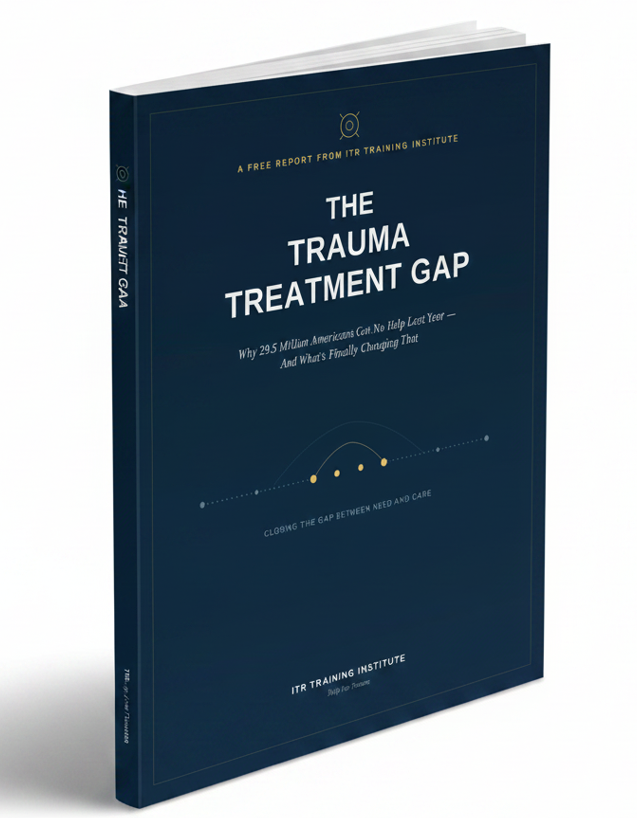
The Trauma Treatment Gap
Too Many Cases. Too Few Clinicians. Methods and Business Models That Can't Keep Up.
If that's why you're frustrated, you're not wrong — and there's a way to change it, starting with your very next session in your own office.
Get Instant Access to this Free Report
🔒 We respect your privacy. Your information will never be sold or shared. You'll receive the report and occasional updates from ITR Training Institute | ITRtraining.com. Unsubscribe anytime with one click.
Also built for chaplains, case managers, healthcare associates, first responders, veterans, foster parents, and family members working alongside, or living with trauma survivors every day
Inside the Trauma Treatment Gap Report:
-
Why the standard trauma-recovery timeline — months, sometimes years — isn't a client problem. It's a workforce and method problem, and what's starting to close it.
-
The "impossible cases": clients who can't remember, won't talk about, or dissociate during sessions — and why that's not actually a dead end.
-
What changed at a large county's Department of Social Services: family reunification timelines cut from 24 months to 6.
-
Running a practice or a clinical team? What changes when you can add certified paraprofessionals to fill the gap giving you more time and money while your whole team shares one method for the cases that usually get passed around.
The Trauma Treatment Gap
Why 29.5 Million Americans Got No Help Last Year -
And What's Finally Changing That?
A free report for everyone already in the room with people who carry trauma -
therapists, healthcare associates, coaches, peer supporters, chaplains,
case managers, first responders, foster parents and family members.

"I have done EMDR, DBT, IFS, CBT and Somatic Experiencing… What I love about this training is that it is the first one that showed how the interventions addressed the different symptom clusters of PTSD."
— Alpha Marcella Gunn, MA, LPC
The clinical model behind this report has drawn recognition from trauma specialists and researchers for years:

Instinctual Trauma Response allows for the gentle and rapid processing of haunting traumatic memories in a matter of days, not months or years. Their sensitivity and compassion, along with their exceptionally astute understanding of trauma and the healing process, have produced a significant breakthrough in the field of trauma treatment. I applaud their work, and enthusiastically recommend ITR to all those who treat and support survivors of trauma.
Glenn Schiraldi, Ph.D., LTC (USAR, Ret) Author of "The Post-Traumatic Stress Disorder Sourcebook,"
"The Resilience Workbook" and
"The Adverse Childhood Experiences Recovery Workbook" and others.
“Whether acute or sustained, the effects of trauma on the brain can lead not only to anguish for the client, but also to frustration for the clinician. These painful conditions, so often resistant to even the most sophisticated therapies, are now, thanks to the dedication of Drs. Tinnin and Gantt, able to be approached with a new and remarkably successful methodology. This is a model for responsible and effective care. I think it's the most amazing methodology to hit the trauma field, and it incorporates all of the current "hot" acronyms in a much more thoughtful and personalized way than any of them.”
Judith A. Rubin, Ph.D., ATR-BC
Department of Psychiatry,
University of Pittsburgh

The therapeutic implications of the ITR concept are profound and are addressed in detail, providing theory and application of techniques that embrace both cognitive and non-verbal somatic/behavioral elements.
Robert Scaer, MD
Author of "The Body Bears the Burden",
"The Trauma Spectrum", and
"Eight Keys to Body-Brain Balance"
ITR Training Institute LLC
364 Patteson Drive #105 Morgantown, WV 26505
800 755 6105
Terms of Service | Privacy Policy
Copyright 2026