“Trauma is the biggest

mental health problem of the 21st century 

and it is the most treatable.”  


-Dr. Louis Tinnin, Psychiatrist and Co-Founder of ITR 

Baltimore County DSS Therapists discuss using ITR. 

Click play to watch:

Video Poster Image

 Too many trauma survivors spend years learning to cope with symptoms while the traumatic experience still feels unfinished.

ITR is a foundational treatment protocol for trauma resolution. The ITR Graphic Narrative® (GN) and Externalized Dialogue® (ExD) techniques externalize internal thoughts, feelings, and implicit memories using visual and narrative processing. 

By organizing these memories into a sequential story, GN and ExD facilitate neuroception utilizing the concept of time to signal to the central nervous system (CNS) and autonomic nervous system (ANS) that the traumatic event is safely in the past. 

At it's core, the Instinctual Trauma Response model recognizes that the ANS is hardwired to react to threats in a systematic, survival-driven manner. When a threat cannot be avoided or escaped, the resulting strain on the ANS becomes what we recognize as trauma. Repeated threats can store sensory-rich injuries across multiple channels (e.g., sight, sound, touch, proprioception), leaving the individual vulnerable to triggers long after the danger has passed.

Over time, this chronic activation impacts the entire central nervous system, including higher-level cognitive functioning a core insight that highlights the clinical genius of Drs. Tinnin and Gantt’s work.

See Testimonials Here


"Trauma is treatable...and it doesn't take long to do it."


-Dr. Louis Tinnin, Psychiatrist and Co-Founder of ITR 

Watch videos where Dr. Tinnin explains more:
Video Poster Image
Video Poster Image
Video Poster Image
Video Poster Image

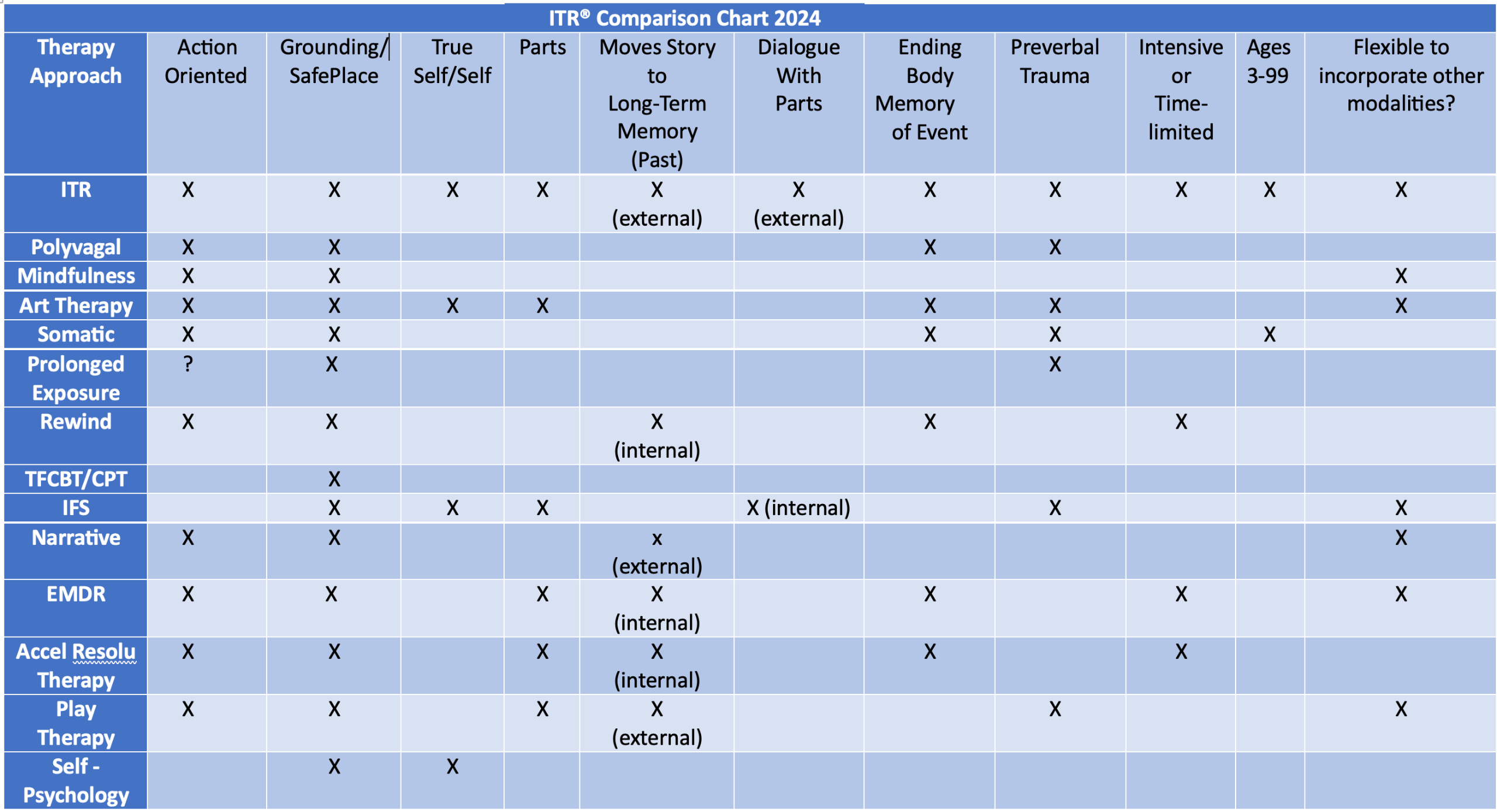
The ITR® Difference

ITR®

Other Approaches

Takes fragments of the traumas that cause flashbacks & nightmares and puts them into historical context with a beginning, middle, and end, so they can be stored in long-term memory and are no longer triggers.

Focus on coping skills (progressive relaxation, deep breathing, thought-stopping).

Images are drawn from an observer perspective to create Graphic Narrative® (doing play therapy with children) using the structure of the Instinctual Trauma Response to organize the event. Words are added to present the story to the whole brain for memory re-consolidation. —“The image comes first”

Uses cognitive skills and reframing.

If a traumatic event is not thoroughly resolved, it feels like the event will happen again. ITR makes it possible to truly “finish the story!”

Concentrates on how the person’s thoughts, feelings, and behaviors are connected in the present.

As the traumas are truly finished, the person will have more capacity for problem-solving and can use Externalized Dialgue® to work with Parts and end dissociation.

What happened in the past is not considered as important as present-day functioning.

Single traumas can be completed in a matter of 1-3 hours. A long history of trauma will take longer in hourly sessions and can be addressed more intensively to get momentum like in 90-180 minute weekly sessions, or in several long weekends, or 15+ hours for in a week. There is not much talking and the structured process is repeated for amy type of trauma so ITR works very well intensively.

Some therapists insist on a long period of stabilization before trauma processing begins; which can be years of weekly sessions.

Can be used with children as young as 3 years old as well as older children, adolescents, and adults.

Young children and those with developmental delays cannot be treated with some types of trauma work.

Does not have an individual re-live the event. The client is a 3rd person observer and the story is put in past tense.

Some approaches stress abreaction (re-experiencing the emotion dissociated from the original trauma) and others use prolonged exposure.

Integrates nonverbal and verbal memories.

Deals primarily with verbal material.

The ITR® Difference

ITR® - Takes fragments of the traumas that cause flashbacks & nightmares and puts them into historical context with a beginning, middle, and end, so they can be stored in long-term memory and are no longer triggers.

Other Approaches - Focus on coping skills (progressive relaxation, deep breathing, thought-stopping).

ITR® - Images are drawn from an observer perspective to create Graphic Narrative® (doing play therapy with children) using the structure of the Instinctual Trauma Response to organize the event. Words are added to present the story to the whole brain for memory re-consolidation. —“The image comes first”

Other Approaches - Uses cognitive skills and reframing.

ITR® - If a traumatic event is not thoroughly resolved, it feels like the event will happen again. ITR makes it possible to truly “finish the story!”

Other Approaches - Concentrates on how the person’s thoughts, feelings, and behaviors are connected in the present.

ITR® - As the traumas are truly finished, the person will have more capacity for problem-solving and can use Externalized Dialgue® to work with Parts and end dissociation.

Other Approaches - What happened in the past is not considered as important as present-day functioning.

ITR® - Single traumas can be completed in a matter of hours; a program can be done as an intensive (20-30 hours per week), several long weekends, or 2-3 hours weekly sessions. Weekly :50 minutes sessions are also successful. It just takes longer.

Other Approaches - Some therapists insist on a long period of stabilization before trauma processing begins; which can be years of weekly sessions.

ITR® - Can be used with children as young as 3 years old as well as older children, adolescents, and adults.

Other Approaches - Young children and those with developmental delays cannot be treated with some types of trauma work.

ITR® - Does not have an individual re-live the event. The client is a 3rd person observer and the story is put in past tense.

Other Approaches - Some approaches stress abreaction (re-experiencing the emotion dissociated from the original trauma) and others use prolonged exposure.

ITR® - Integrates nonverbal and verbal memories.

Other Approaches - Deals primarily with verbal material.

ITR Training Institute

Call 800-755-6105 or Click Below


Contact Us
Discover how trauma impacts the brain and how healing is possible. "Demystifying Trauma" - Get it sent straight to your inbox:

You'll also get the latest news and course offers. You can unsubscribe at any time.